PHYSICS 111(02): QUIZ 05
Answers are at bottom of page.
- A copper bar of length L, width w, and thickness t has an electrical resistance of R. If the bar is now cut lengthwise and the two pieces joined to form a copper bar of length 2L, width ½w, and thickness t, the resistance of this new bar is:
- (A) ¼ R
- (B) ½ R
- (C) R
- (D) 2 R
- (E) 4 R
- A light bulb of resistance R is connected to an ideal battery of emf E. The power dissipated by the light bulb is P. If the battery is replaced by one with an emf of 2 E, the power dissipated by the same light bulb is:
- (A) ¼ P
- (B) ½ P
- (C) P
- (D) 2 P
- (E) 4 P
- You have three resistors and wish to connect them so as to obtain the minimum possible equivalent resistance. You should
- (A) connect the three resistors in series;
- (B) connect the three resistors in parallel;
- (C) connect the smallest resistance in series with the parallel combination of the other two;
- (D) connect the largest resistance in series with the parallel combination of the other two;
- (E) connect them however you wish, the equivalent resistance does not depend on how the resistors are connected.
- In cold weather the internal resistance of a battery is higher than in warm weather. When a particular load resistance R is connected to the battery:
- (A) The TPD (terminal potential difference) and the current, I, drawn from the battery are higher in cold weather than in warm;
- (B) The TPD is higher and I is lower in cold weather than in warm;
- (C) The TPD is lower and I is higher in cold weather than in warm;
- (D) The TPD and I are lower in cold weather than in warm;
- (E) There is no change in the TPD, but I is lower in cold weather than in warm.
- Which statement best explains why a constant magnetic field does no work on a moving charged particle?
- (A) The magnetic field is conservative.
- (B) The magnetic force is a velocity dependent force.
- (C) the magnetic field is a vector and work is a scalar quantity.
- (D) The magnetic force is always perpendicular to the velocity of the particle.
- (E) The electric field associated with the particle cancels the effect of the magnetic field on the particle.
- Which one of the following statements concerning electromagnetic waves is FALSE?
- (A) They are longitudinal waves.
- (B) They transfer energy through space.
- (C) Their existence was predicted by Maxwell.
- (D) They can propagate through a material substance.
- (E) They can propagate through a vacuum.
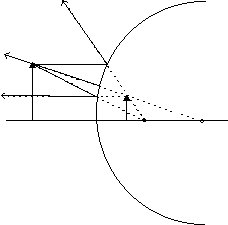
- Which statement correctly describes the image formed by a convex spherical mirror?
- (A) always upright, virtual, enlarged
- (B) always upright, virtual, reduced
- (C) upright, virtual, enlarged if object closer to mirror than focal point
- (D) always inverted, real, reduced
- (E) always inverted, real, enlarged
- A beam of light in air (n = 1) strikes a glass block (n > 1) at an angle of incidence that is between 0 and 90°. Which of the following statements is correct?
- (A) The light is totally transmitted into the glass block if the angle of incidence is less than the critical angle.
- (B) The light is totally transmitted into the glass block if the angle of incidence is greater than the critical angle.
- (C) The light is partially transmitted and partially reflected at the air-glass interface.
- (D) The light is totally reflected at the air-glass interface if the angle of incidence is less than the critical angle.
- (E) The light is totally reflected at the air-glass interface if the angle of incidence is greater than the critical angle.
- A person's contact lens prescription is –2.00 diopters. Which of the following statements best describes this person's vision defect and the corrective lens?
- (A) The person is nearsighted, the lens is diverging with focal point 2.00 m from the lens.
- (B) The person is nearsighted, the lens is diverging with focal point 50 cm from the lens.
- (C) The person is farsighted, the lens is converging with focal point 2.00 m from the lens.
- (D) The person is farsighted, the lens is converging with focal point 50 cm from the lens.
- (E) The person is farsighted, the lens is diverging with focal point 2.00 m from the lens.
- You are given two opaque disks. The diameter of disk 1 is twice that of disk 2 (d1 = 2
d2). Disk 1 is placed 80 cm from your eye. By holding disk 2 at an appropriate location you are able to just obscure your view of disk 1 (i.e. the angular sizes of the disks are equal.) The distance of disk 2 from your eye is:
- (A) 10 cm
- (B) 20 cm
- (C) 30 cm
- (D) 40 cm
- (E) 50 cm
ANSWERS:
- (E) - Since resistance of an object of uniform shape and composition is directly proportional to length and inversely proportional to cross-sectional area, and since the new bar is twice as long and has only half the cross-sectional area as the original bar, the new resistance is 4 × that of the original bar.
- (E) - From P = V2/R, doubling the emf quadruples the power (for same resistance).
- (B) - For a parallel connection, the equivalent resistance is less than any of the individual resistances. Any of the other options results in an equivalent resistance greater than the smallest resistance.
- (D) - Higher internal resistance, r, means higher total resistance, r + R, and therefore lower current (Ohm's Law). Lower current means lower TPD, since TPD = IR.
- (D) - Since the magnetic force is always perpendicular to the velocity (and therefore displacement) the angle b/w the force and the displacement is 90°, and since cos 90° = 0, the work is 0.
- (A) - Since the electric and magnetic fields in an electromagnetic wave are mutually perpendicular and perpendicular to the direction of propagation, electromagnetic waves are transverse waves.
-
|
(B) - From the ray diagram, it is seen that the image formed by a convex spherical mirror is always upright, virtual, and reduced.
|
|
- (C) - There is no critical angle of incidence when light passes into a medium of greater refractive index.
- (B) - A negative refractive power means a negative focal length and therefore a diverging corrective lens. Therefore the person is nearsighted and the lens focal point is (1/2.00) m = 50 cm from the lens.
- (D) - Since disk 2 is half the size of disk 1, it must be placed half the distance away for it to have the same angular size as disk 1.
Return to Resources Page
|