PHYSICS 111(02): QUIZ 06
Answers are at bottom of page.
- A beam of light consists of 600 nm orange light and 400 nm violet light. The beam strikes a diffraction grating at normal incidence (angle of incidence = 0). Which of the following statements is correct?
- (A) The violet 1st order maximum occurs at a larger angle, measured relative to the incident direction, than the orange 1st order maximum.The violet 1st order maximum occurs at a larger angle, measured relative to the incident direction, than the orange 1st order maximum.
- (B) The orange 1st order max. occurs at a larger angle than the violet 2nd order max.
- (C) The orange 2nd order max. occurs at a larger angle than the violet 3rd order max.
- (D) The orange 2nd order max. occurs at the same angle as the violet 3rd order max.
- (E) The orange 3rd order max. occurs at a larger angle than the violet 5th order max.
- Consider a beam of red light and a beam of blue light travelling through a vacuum:
- (A) The red light photons have higher energy than the blue light photons;
- (B) The red light photons have higher frequency than the blue light photons;
- (C) The red light photons have higher wavelength than the blue light photons;
- (D) The red light photons have higher speed than the blue light photons;
- (E) Photons in each beam have the same energy.
- A metal surface is illuminated with light of a particular frequency, and photoelectrons are ejected. The light source is now adjusted so that the light is of higher intensity (but same frequency). The result when the metal surface is illuminated with this higher intensity light is:
- (A) electrons are ejected at a greater rate and their maximum kinetic energy is unchanged;
- (B) electrons are ejected at a greater rate but their maximum kinetic energy is lower;
- (C) electrons are ejected at a lesser rate but their maximum kinetic energy is higher;
- (D) electrons are ejected at a lesser rate and their maximum kinetic energy is lower;
- (E) electrons are no longer ejected from the metal surface.
- Compton studied the scattering of X-rays from a graphite target. He observed that
- (A) some of the scattered X-rays had smaller wavelengths than the incident X-rays.
- (B) some of the scattered X-rays had larger wavelengths than the incident X-rays.
- (C) all of the scattered X-rays had the same wavelength as the incident X-rays.
- (D) some of the scattered X-rays had larger frequencies than the incident X-rays.
- (E) some of the scattered X-rays had larger masses than the incident X-rays.
- When a hydrogen atom makes the transition from the n = 3 state to the n = 2 state
- (A) a photon is absorbed and the atom has higher energy.
- (B) a photon is absorbed and the atom has lower energy.
- (C) a photon is emitted and the atom has lower energy.
- (D) a photon is emitted and the energy of the atom does not change.
- (E) a photon is absorbed and the energy of the atom does not change.
- Which of the following statements correctly describes the result of increasing the voltage applied across an X-ray tube?
- (A) Both the characteristic K-alpha peak wavelength and the minimum X-ray wavelength decrease.
- (B) The characteristic K-alpha peak wavelength decreases and the minimum X-ray wavelength does not change.
- (C) The characteristic K-alpha peak wavelength increases and the minimum X-ray wavelength decreases.
- (D) Both the characteristic K-alpha peak wavelength and the minimum X-ray wavelength increase.
- (E) The characteristic K-alpha peak wavelength does not change and the minimum X-ray wavelength decreases.
- Laser light is produced by a process called:
- (A) stimulated emission
- (B) spontaneous emission
- (C) blackbody radiation
- (D) thermal radiation
- (E) Compton scattering
- If a nucleus containing A nucleons has a radius of r, then a nucleus containing 8A nucleons has a radius of approximately:
- (A) 2r
- (B) 4r
- (C) 8r
- (D) 2.7r
- (E) 16r
- Which of the following statements regarding the strong nuclear force is TRUE?
- (A) The strong nuclear force between two protons is repulsive.
- (B) The strong nuclear force follows an inverse square of distance dependence.
- (C) In a large nucleus, each nucleon is acted on by the strong nuclear force due to all the other nucleons in the nucleus.
- (D) The strong nuclear force between two neutrons is 0.
- (E) The strong nuclear force is very short-ranged.
- The radioactive decay of 3617Cl to 3618Ar is an example of:
- (A) beta– decay
- (B) beta+ decay
- (C) gamma decay
- (D) alpha decay
- (E) neutron absorption
ANSWERS:
- (D) - From the equation for the locations of interference
maxima,
 , the angles of the maxima depend on the product of the order, m, and the wavelength, , the angles of the maxima depend on the product of the order, m, and the wavelength,  . Therefore, the orange 2nd order maximum occurs at the same angle as the violet 3rd order maximum since 2×(600 nm) equals 3×(400 nm). . Therefore, the orange 2nd order maximum occurs at the same angle as the violet 3rd order maximum since 2×(600 nm) equals 3×(400 nm).
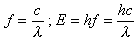
- (C) - The wavelength of red light is about 700 nm and that of blue light is about 450 nm. (Speed, c, is the same for all e-m radiation propagating in a vacuum; frequency and photon energy are inversely related to wavelength,
 ) )
- (A) - Same frequency of light means that the photon energy is unchanged and therefore so is the maximum electron kinetic energy unchanged (hf = KEmax + Wo). Higher intensity of light means more photons per unit time are striking the metal surface and therefore electrons will be ejected at a greater rate.
- (B) - X-rays scattering from electrons in the target have larger wavelengths (lower energy) due to transfer of energy to the electrons. (Compton equation is obtained by applying conservation of linear momentum and energy to the photon-electron 'collision'.)
- (C) - A lower quantum number means a lower energy state. The difference in energy is carried away by the emitted photon.
- (E) - The K-alpha peak wavelength is a property of the tube anode material and does not depend on the applied tube voltage. Since the maximum X-ray energy depends directly on the applied tube voltage and X-ray wavelength is inversely related to X-ray energy, the minimum X-ray wavelength decreases with an increase in tube voltage.
- (A)
- (A) - Since nuclear radius varies as the cube root of the mass number, and the cube root of 8 is 2, the nucleus with mass number 8 will have a radius of approximately 2r.
- (E) - The strong nuclear force is very short-ranged, each nucleon only feeling the strong nuclear attraction due to its 'nearest
neighbours'.
- (A) - Since the nucleon number of the daughter is the same as that of the parent, this cannot be alpha decay. Since the atomic number of the daughter is one greater than that of the parent, the charge of the decay particle must be -1e. The particle with mass number 0 and charge of -e is the electron, so this is an example of beta- decay.
Return to Resources Page
| /tr>