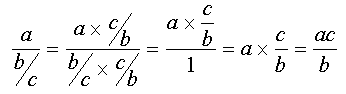
Algebra ReviewFractionsA fraction's value is unchanged if the numerator and denominator are each multiplied or divided by the same quantity. Thus the following relations hold:
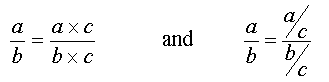
and therefore,
| ||||||||||||
ExponentsRaising a number y to an exponent n (the nth power) means that y is multiplied by itself n times. e.g. y2 = y × yNote that y2 × y3 = (y × y) × (y × y × y) = y5so ym × yn = ym+nand (y2)3 = (y × y) × (y × y) × (y × y) = y6so (ym)n = ym×n
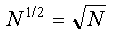
Exponents need not be integers, they can be fractions, less than 1, negative, ... A negative exponent denotes the reciprocal of the number with positive exponent:
e.g.
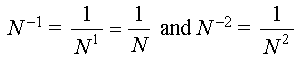
Note that:

| ||||||||||||
LogarithmsAny number y can be written as another number A raised to an exponent x. Neither A nor x need be integers.i.e. y = Axx = logAylogA(y) = x means Ax = yBase 10 (A = 10) gives the common logarithms, denoted log
Base e (A = e = 2.71828...)gives the natural logarithms, denoted ln
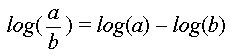
Logarithm relations:
log(ab) = log(a) + log(b)
log(yn) = n log(y)
| ||||||||||||
EquationsAn equation is not changed if the same operation is performed on each side of the equation.Suppose A + B = C + D(A + B) + M = (C + D) + M(A + B) - M = (C + D) - M(A + B) × M = (C + D) × M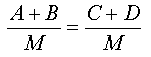
(A + B)n = (C + D)n
AC + BC = C × (A + B) = (A + B) × C | ||||||||||||
Quadratic EquationsAn equation is said to be QUADRATIC in a variable if the variable appears to the first and second powers.The general form of a quadratic equation:
ax2 + bx + c = 0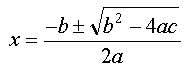
| ||||||||||||
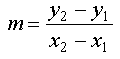
Linear EquationsThe general equation for a straight line is:y = mx + bThe slope can be determined graphically by choosing any two points on the line and using
The y-intercept can either be read directly from the graph or, once the slope is known, calculated by using the line equation: b = y1 - mx1
|