Interactive Quiz #3
This self-graded quiz consists of 10 questions (Part A of the 1996/97 Test 3). Answers are entered by clicking the option button corresponding to your selection. The quiz is graded by clicking the "Grade Quiz" button at the end of the quiz. Correct answers are found through hypertext links located at the end of the quiz.
|
Correct Answers
#1,
#2,
#3,
#4,
#5,
#6,
#7,
#8,
#9,
#10
|
| 1. Water flows through a pipe as shown in the figure. The flow is steady and non-viscous. Which of the following statements is correct?
|
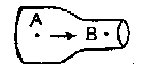 |
(B) The pressure at A is greater than at B.
Sections 11.8 and 11.9 of the text. From the continuity equation, the flow speed is lower at A than at B. Therefore, from Bernoulli's equation the pressure at A is greater than at B.
|
2. A wave moves along a string at constant speed. Which of the following statements concerning the motion of individual particles in the string is correct?
(B) The particle speed varies sinusoidally with time.
Sections 10.4 and 16.2 of the text. For a harmonic wave, each point in the medium vibrates in simple harmonic motion, and the speed of a particle undergoing SHM varies sinusoidally with time.
|
3. The tension in a taut rope is increased by a factor of 9. How does the speed of wave pulses on the rope change?
(D) It is increased by a factor of 3.
Section 16.3 of text. The speed of a wave on a stretched string varies as the square root of the tension.
|
4. In a guitar string, where there is a standing wave of wavelength  the distance from one fixed end to the nearest node the distance from one fixed end to the nearest node
(B) is ½ .
Section 17.5 of the text. A fixed end is a node, and the distance between consecutive nodes is one-half wavelength.
|
5. A conducting ball, initially uncharged, is sitting on an uncharged insulating surface. A grounding wire is now connected to the ball. Which of the following statements best described the situation resulting when a positively-charged rod is brought near the ball?
(A) Negative charges flow from the ground onto the conducting ball.
Section 18.4 of text. Because of their attraction to the positively-charged rod, negative charges flow from ground through the wire onto the conducting ball.
|
6. Which statement best explains why tiny bits of paper are attracted to a negatively charged rubber rod?
(C) The paper becomes polarized by induction.
Section 18.4 (Figure 18.9) of text.
|
|
7. Consider two charges, of opposite polarity and equal magnitude Q, arranged as shown. Which of the following statements is correct concerning the net electric field at point P? |
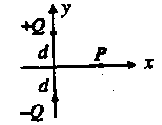 |
(E) The electric field at P is in the negative y direction.
Section 18.6 of text. Electric field points away from a positive charge and toward a negative charge. The net electric field due to a charge distribution is given by the vector sum of the electric fields due to each of the charges in the distribution.
|
8. One joule of work is required to move a one-coulomb point charge from point A to point B in a uniform electric field. This indicates that
(B) the potential difference between points A and B is 1.00 volt.
Section 19.2 of text (definition of potential difference and unit of volt).
|
|
9. Four point charges, each with charge +Q, are placed at the corners of a square as shown. The length of the diagonal of the square is 2a. What is the absolute electric potential at point P, at the centre of the square? |
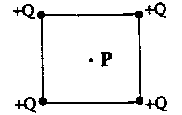 |
Section 19.3. The net absolute electrostatic potential due to a charge distribution is given by the algebraic sum of the potentials due to the individual charges in the distribution.
|
10. The resistance of a certain heater wire is found to be independent of its temperature. If the current through the heater wire is doubled, the rate at which heat is given out by the heater will
(C) increase by a factor of four.
Section 20.4 of text. Rate of heat emission is power and P = I2R.
Click here to return to the beginning of the test.
|